
Digital Detox Analysis for BRICK
* This analysis was conducted independently as a student project for my UX Research Fundamentals class and does not represent an official client deliverable.
THE QUESTION: How do digital detoxes actually work, and what makes them effective?
PROJECT RUNDOWN:
Completed in a UX Fundamentals class, this 9-week independent research project examined how people attempt to reduce digital distractions. Specifically, the goal was to collect data and produce deliverables for BRICK.
Using survey data and naturalistic user commentary online, the study surfaced cross-method patterns across detox strategies and translated them into product recommendations.
Although the project had BRICK as the stakeholder, rather than evaluating their product alone, the study compared multiple detox approaches to identify mechanisms that generalize across products.
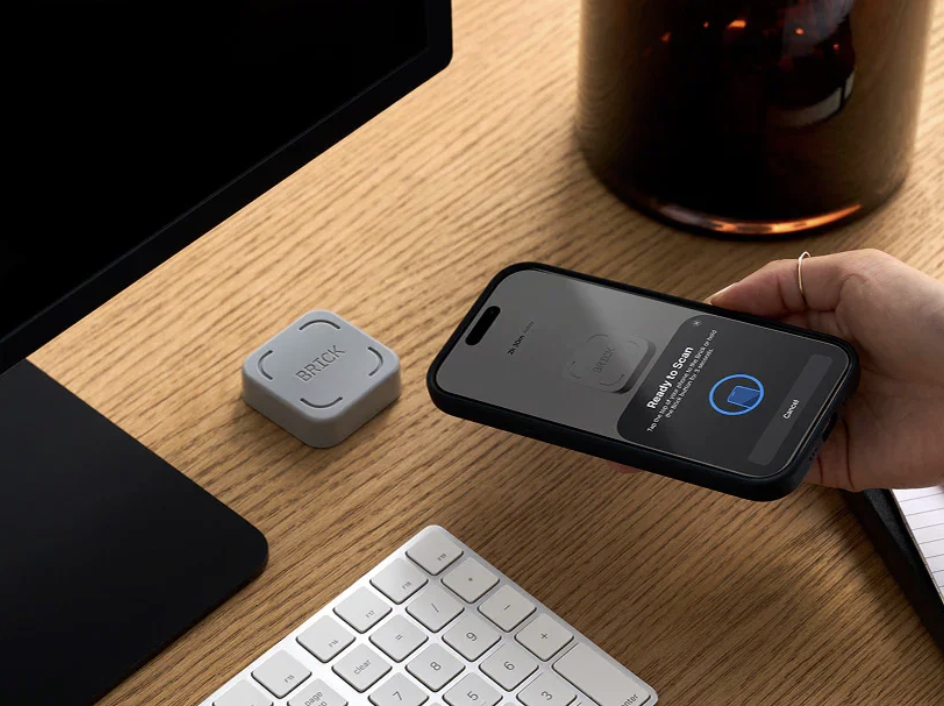
Photo credit: https://getbrick.com/
Using survey data and naturalistic user commentary online, the study surfaced cross-method patterns across detox strategies and translated them into product recommendations.
Although the project had BRICK as the stakeholder, rather than evaluating their product alone, the study compared multiple detox approaches to identify mechanisms that generalize across products.
MY ROLE & RESPONSIBILITIES
- Study design and research framing
- Participant recruitment via online communities
- Qualitative synthesis of survey responses
- Behavioral pattern identification
- Translation of insights into product implications
METHODS:
- Research plan: Survey design; qualitative thematic analysis; cross-method synthesis
- Analysis & synthesis: Thematic coding; pattern identification; insight synthesis
- Recruitment & data collection: Reddit community sourcing; online survey deployment
- Tools used: Figma; Qualtrics
THE IMPACT:
- Identified recurring behavioral patterns across multiple digital detox approaches
- Identified opportunities to strengthen tools through intentional friction and adaptive support
- Reframed digital distraction as an intervention design challenge rather than an awareness problem
The Survey:
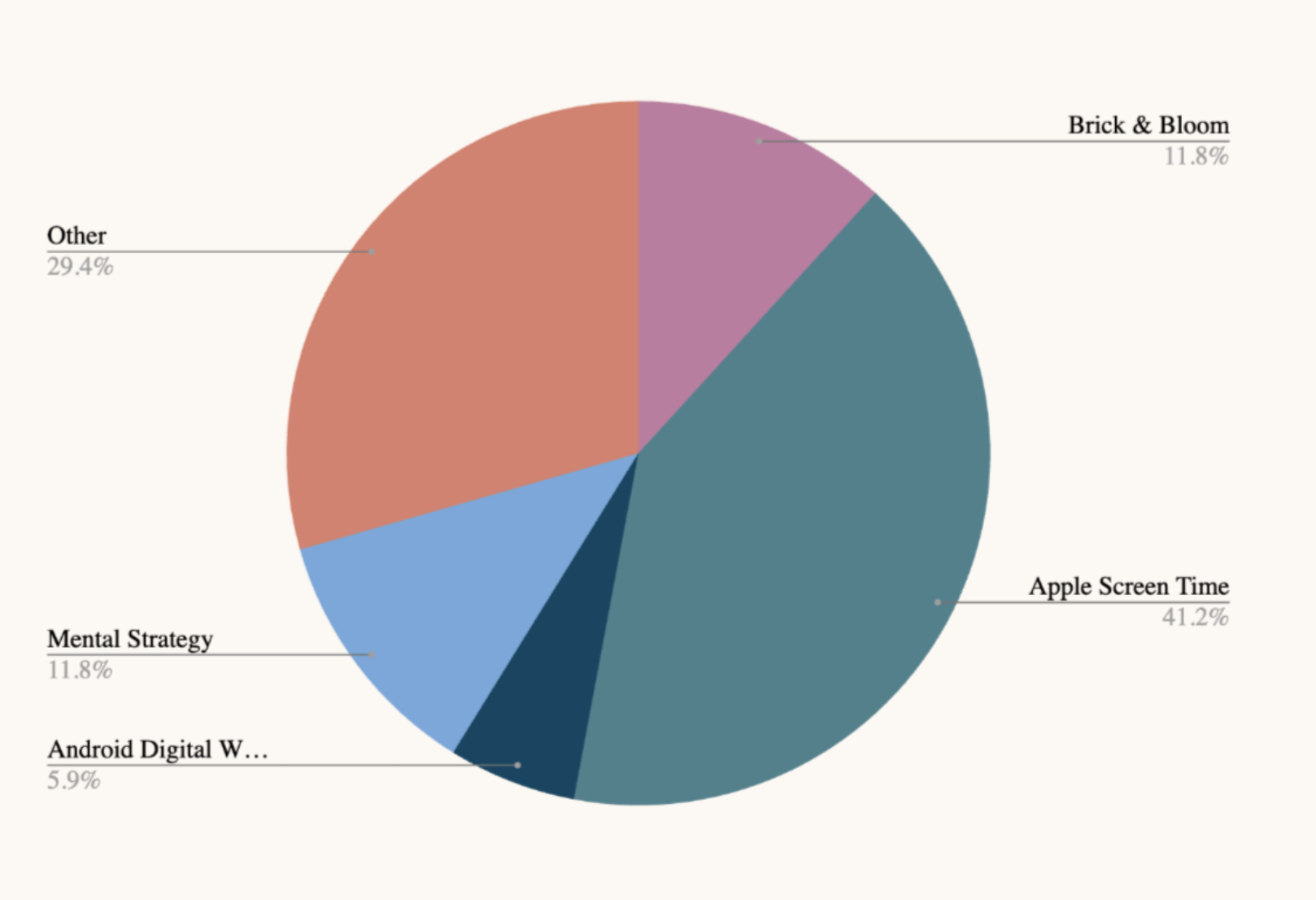
Although the project's ultimate focus was Brick, the study covered a wide range of screentime management methods.
Especially since Brick exists in a vast market of digital detox tools and methods, comparing the product against free (built-in) tools like Apple Screen Time or Android Digital Wellbeing provided a more comprehensive view of the field.
Most individuals were recruited through Reddit—specifically on threads discussing digital wellbeing and screentime—as they represent the market of people actively wanting to change their behavior.
The Results:
1. Effort-based deterrence is more powerful than time limits.
- Small inconveniences (reinstalling apps, physical separation) outperform digital timers
- App deletion was cited as highly effective because re-downloading felt "too annoying"
- Users described laziness as a surprisingly useful constraint
"The effort to redownload an app is greater than the effort to find something else to do (i.e., I am lazy to redownload)."
— Respondent who found success only after deleting all distracting apps
Recommendation: Lean into effort-based friction rather than time-based restrictions alone.
2. Users become easily desensitized to intervention methods.
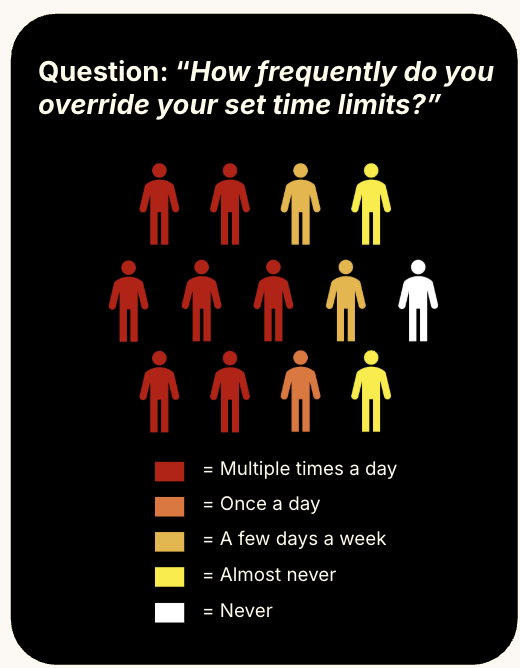
- 10/13 participants reported they regularly "override" time limits they set on apps.
- Many users explicitly stated they override limits "without thinking."
- Effectiveness improved only when others set passwords or access was externally restricted
Recommendation: Lean into effort-based friction rather than time-based restrictions alone.
3. The majority of participants believe digital distraction can't be solved by tools alone.
- Respondents described distraction as psychological, cultural, or structural
- Tools were framed as support systems, not cures
"[Apple Screen Time is] effective as a log but requires personal buy-in and mental strategy to not fade into the background as just another thing to keep track of."
— Unsatisfied Apple Screen Time user
Recommendation: Position Brick as scaffolding for behavior change rather than a standalone fix.
4. Most participants want flexibility rather than total restriction.
- Participants frequently mentioned needing access for work, emergencies, or coordination
- Several described abandoning tools that prevented necessary access
- Flexible tools were more likely to be sustained
"The inflexibility of [the methods] made me abandon them. I need Facebook during natural disasters (sounds wild but we've had three this year) and also to coordinate with volunteer groups. I'd end up abandoning other tools because they would prevent me being able to access facebook when I needed too."
— Apple Screen Time ex-user
Recommendation: Balance restriction with personalized, flexible access settings.
PROJECT WRAP-UP:
Across methods, the most durable detox strategies share a common shape: they raise the cost of relapse, resist habituation, and leave room for the messy realities of everyday life. For BRICK specifically, the strongest opportunity is to position the product as scaffolding for sustained behavior change — pairing physical friction with flexible, user-controlled access rather than competing with built-in tools on restriction alone.